


Welding is a practical skill that delivers real, practical results in the workplace and at home. From DIY repairs and automotive work to fabrication and structural projects, welding allows you to repair, fabricate, reinforce, and build with metal in a way that is permanent, precise, durable, and reliable. The fundamentals of welding stay the same, no matter if you’re working in a garage, at a shipyard, on a building site, or learning for future trade work.
Getting started isn't complicated, but doing it properly from the beginning makes a significant difference to your success as a welder. For beginners, welding can feel overwhelming because there are so many tools, processes, gear, and safety considerations involved. The right process, personal protective equipment, welding gear, and setup determine how quickly you take to welding, and how fast you improve.
This beginner's guide breaks down:
- What welding is
- Choosing the most suitable method and techniques
- Setting up reliably
- Understanding welding safety
- Developing strong habits that lead to consistent results
- Welding tips and tricks
- Tools and gear you need
Understanding Welding at a Practical Level
Welding is the process of melting and fusing metals using heat. In most beginner applications, the heat is generated by an electric arc. As the base metal melts, a filler material is added to strengthen the joint. When the molten metal cools, it forms a solid, permanent bond.
This permanence is what makes welding different from other bonding methods, like bolting or riveting. A good weld becomes part of the material itself, not just holding things together, but transforming them into a single, usable piece.
Because of this, welding demands extreme control. Small inconsistencies in heat, movement, material, or preparation can affect the strength and appearance of the final result. That's why building good habits early is far more important than rushing into complex projects.

The Main Welding Processes Beginners Should Know
Before you buy welding equipment or strike your first arc, it's important to understand the three primary welding methods used in beginner and home setups. Each method has its strengths, and choosing the right one can significantly speed up your learning process.
MIG Welding (Gas Metal Arc Welding)
MIG welding is widely regarded as the best starting point for beginners. It uses a continuously fed wire electrode along with shielding gas to protect the weld from contamination.
What makes MIG welding so effective for beginners is its simplicity. The process is relatively forgiving, and it allows you to focus on developing steady movement and consistency without managing too many variables at once.
The main benefits of MIG welding are that it’s:
- Easy to learn and operate
- Capable of producing clean, consistent welds
- Suitable for a wide range of materials and thicknesses
This type of welding is most commonly used for automotive work, general fabrication, manufacturing, and home projects. For most beginners, MIG welding provides the fastest path to confidence and control.
TIG Welding (Gas Tungsten Arc Welding)
TIG welding is more advanced and requires greater coordination. Instead of feeding wire automatically, the welder controls a tungsten electrode with one hand while manually adding filler material with the other.
This method offers:
- Extremely precise and clean welds
- Greater control over heat input
- Excellent results on thin materials
TIG welding is often used for stainless steel, aluminum, titanium, copper alloys, and magnesium. It’s also favored for projects where precision and appearance are important, such as aerospace and racing cars. However, it takes more time to master, making it better suited as a second step after learning MIG welding.
Stick Welding (Shielded Metal Arc Welding)
Stick welding is one of the most durable and versatile welding methods, especially in less controlled environments. It uses a flux-coated electrode that creates its own shielding gas as it burns.
The advantages of stick welding include:
- Strong performance outdoors and in windy conditions
- An ability to weld dirty or rusty metal
- Simple and rugged equipment
While it can be less refined in appearance, stick welding is very practical for repairs and heavy-duty applications.

The Equipment You Need to Start Up
One of the most common misconceptions about welding is that you need a lot of expensive gear. In reality, you only need a few pieces of reliable equipment to begin. The emphasis should always be on quality and consistency, not quantity.
Welding Machine
A welding machine is the core piece of your setup. For beginners, a MIG welder is typically the best choice because it balances ease of use with versatility.
When selecting a machine, focus on:
- Amperance range (determines metal thickness capability)
- Input voltage: 120V (light-duty, beginners/hobbyists) vs 240V (heavy-duty, industrial)
- Duty cycle: The percentage of a 10-minute period the welder can operate safely at a given amperage without overheating, usually based on a 40°C environment
- Ease of setup and adjustment
Avoid overcomplicating your purchase. A straightforward, dependable machine will help you progress faster than a feature-heavy one that you don't fully understand or know how to use. You should pair your welding machine with a good foot pedal that provides good control over temperature and amperage.
Welding Helmet
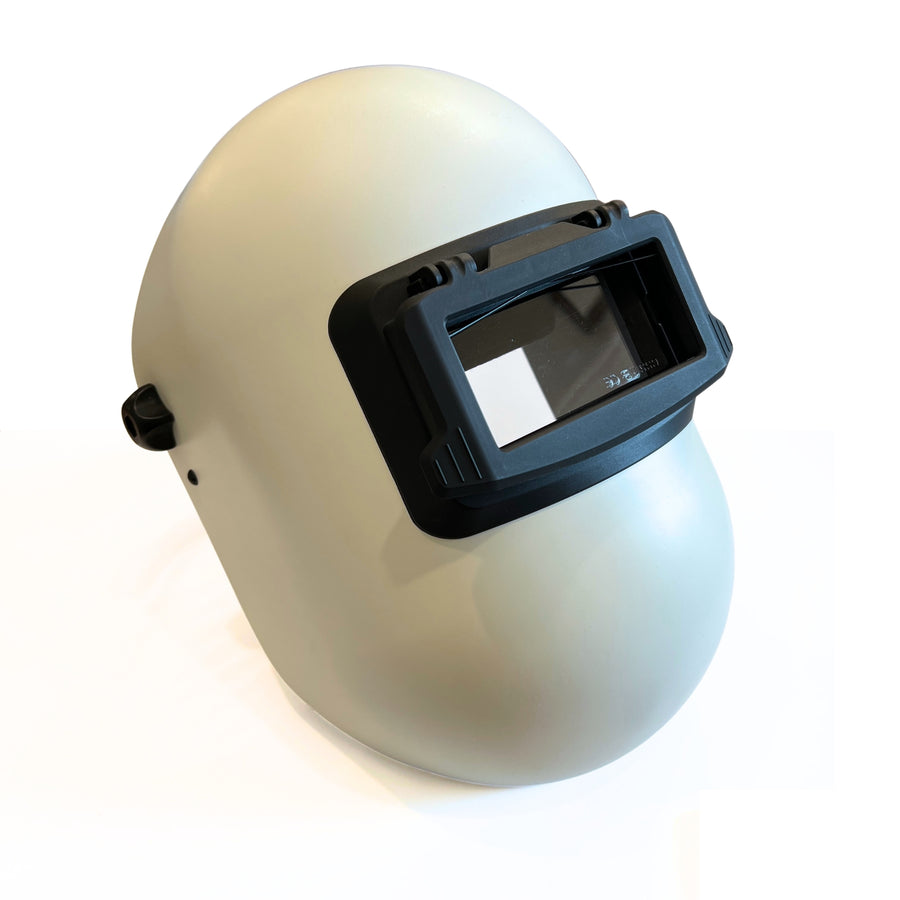
If there's one piece of equipment that directly impacts both your safety and welding quality, it's your helmet. It does more than just protect your eyes from the arc; it determines how clearly you can see the weld pool. If you can't see properly, you can't weld consistently.
Our welding helmets consistently perform precisely because they're built to do the job without unnecessary complexities. All helmet variations are made of fiberglass, so they're durable, fire-resistant, lightweight, and hold up well during repeated use. A full one-year warranty also backs them against quality issues, so if there's a problem, it's covered.
One of the most practical advantages of our helmets is lens compatibility. They're designed to fit any welding lens thickness, giving them an edge over more generic brands. Many standard helmets restrict lens size or thickness, which can be a problem when you change or upgrade lenses. That limitation is completely removed here. Our helmets don’t currently support cheater lenses, so if you rely on magnification, you'll need to account for that in your setup. As a beginner, you likely won't need magnification, so this isn't a problem.
Welding Lenses
Your lens is just as important as the helmet itself because it controls both visibility and eye protection. A good lens allows you to clearly track the weld pool, maintain position, enable precise work, and make consistent adjustments while welding. At the same time, it protects your eyes from harmful radiation.
Like our helmets, our welding lenses are designed to fit seamlessly into the helmets, with the current exception of cheater lenses. Because the helmets fit any thickness, you're free to select lenses that work best for you.
The setup is straightforward:
- A welding lens for visibility and protection
- A clear lens as an outer layer to protect the main lens
Clear lenses prevent damage from sparks, spatter, scratches, and UV radiation. It helps keep your primary lens in better condition and maintains consistent visibility over time, which matters more than most beginners realize. A scratched or worn lens reduces clarity, making it harder to read the weld pool and control your movements. Replacing a clear lens is simple and cost-effective; replacing a damaged welding lens is not.
You could also look at getting auto-darkening welding lenses, which give you a high-definition view of the pool, helping you see impurities in the weld metal more easily.
If you’re unsure which lens shade or tint is best for your needs, our welding lens color guide breaks down each option, highlighting the differences and when each is most effective.
Protective Clothing
Welding exposes you to sparks, molten metals, UV radiation, and intense heat. Proper protective clothing is essential, not optional.
The protective clothing every welder needs includes:
- Flame-resistant jacket
- Heavy-duty welding gloves
- Steel-toe boots
- Long, non-synthetic trousers
Avoid any synthetic materials as they can melt under heat. Keeping your skin fully covered is one of the simplest and most effective safety measures you can take.
For a beginner's guide to helmets, lenses, gear, and basic tools, check out this best welding tools and gear guide.

Why a High-Quality Helmet Improves Your Welding
Many beginners underestimate the role their helmet plays in their skill development. Poor visibility can cause dangerous hesitation, uneven movement, eye injuries, and inconsistent welds.
A well-designed helmet helps eliminate these issues by providing:
- Clear, stable visibility
- Durable construction
- Consistent performance
- Flexible lens options
Trusting your helmet lets you focus entirely on your technique rather than compensating for equipment limitations. In practical terms, a better helmet doesn't just protect you, it actively improves your ability to weld.
Ventilation and Workspace Setup
There are a few things to consider when buying your first welder, particularly for your safety. Welding produces fumes that should never be inhaled, especially in enclosed spaces.
Your workspace should include:
- A non-flammable welding table
- Proper extraction devices
- A fire extinguisher within easy reach
- A clean, organized layout
Taking the time to set up your workspace correctly reduces the risk of injury or accidents and makes your metal casting work more efficient.
Learning the Fundamentals of Welding Technique
Once your equipment is ready, shift your focus to technique. Welding is a skill built through time and repetition, but developing the right habits early will significantly accelerate your progress.
Torch Position and Angle
Maintaining a consistent angle, typically around 10 to 15 degrees, helps ensure proper penetration and a stable weld. Pinch the handle of the stick welder between your thumb and index finger, as if you're holding a pencil, and rest it across your palm, keeping your wrist straight.
Travel Speed
Speed plays a major role in weld quality. Moving too quickly results in weak welds, while moving too slowly creates excess buildup. Consistency is more important than speed, so focus on maintaining steady movement rather than rushing.
Reading the Weld Pool
The weld pool is your most important visual guide. It shows how the metal is melting and how the joint is forming in real time.
Once you know how to read the weld pool, you'll be able to:
- Adjust your speed
- Control heat input
- Maintain consistent weld quality
This is where a high-quality helmet becomes especially important. Clear visibility makes it far easier to interpret what's happening mid-weld and respond accordingly. Your finished welds will be far neater and of higher quality.

Common Mistakes Beginners Should Avoid
Every welder makes mistakes when starting, but that's part of the learning process. Some mistakes help you to improve, while others slow your progress and lead to frustration. Understanding the most common issues allows you to correct them quickly and build better habits from the start.
Poor Surface Preparation
Beginners often try to weld directly onto dirty, painted, or rusted metal, which creates weak, inconsistent welds because contaminants interfere with the arc and prevent proper fusion. Welding always works best on a clean metal surface.
Incorrect Machine Settings
Many beginners either guess their settings or rely on default configurations without understanding how they affect the weld. If the voltage or wire speed is too high or low, the weld will suffer, either due to insufficient penetration or excessive buildup.
Uneven Movement
Welding requires steady, controlled motion, and if your hand changes speed throughout the weld, the result will be uneven. This tends to happen when you're unsure of your positioning or can't clearly see the weld pool.
Misreading the Weld Pool
Beginners often focus too much on the torch and not enough on how the molten metal behaves. The weld pool tells you if your settings and technique are correct, so if you're not paying attention, you're basically just guessing.
Avoiding these simple mistakes doesn't mean you won't make errors. It means you'll recognize them early and correct them faster. Welding is a skill built on repetition and adjustment, and the sooner you develop good habits, the quicker your results will improve.
First Welder Projects to Build Skills
To build your skills, start with small, manageable projects that allow for repetition and refinement, then move on to more complex projects. Examples include:
- Basic brackets
- Small metal sculptures
- Simple shelves
- Bookends
- Coffee stools
- Art deco pieces
These simple projects build confidence and reinforce fundamental skills.
Frequently Asked Questions
What Is the Easiest Type of Welding to Learn?
MIG welding is the most common type of welding due to its simplicity and reliability. MIG welding machines are the best choice for beginners.
Do I Need an Expensive Helmet to Start?
You don’t necessarily need an expensive helmet, but it should be well-fitting, protective, hardy, and comfortable. Clear visibility and durability are more important than extra features.
Are Ridge Products Welding Helmets a Good Option?
Yes. Our helmets offer durable fiberglass construction, consistent performance, and compatibility with any lens thickness, making them practical for long-term use.
What Metals Can You Weld?
You can weld all types of metals, including aluminum alloys, structural steel, copper alloys, brass, and cast iron. You can also weld more exotic metals, like titanium and niobium, with practice.
Conclusion
Welding is a skill built on repetition, control, and the right equipment. Beginners need a clear starting point and reliable tools, so start with MIG welding. Focus on developing a strong foundation and practice consistently. Also, invest in equipment that supports your progress.
A reliable helmet can make a significant difference in both your learning experience and your results, as can other welding gear. When you can see clearly and work comfortably, you'll develop better habits, discover new tools, and produce better results.