


The welding helmet you wear can make or break your entire process. It affects how you see the weld pool and how your neck feels after a full shift. The hood is the protective shell on your head, while the lens is the viewing window that darkens when you weld. All welding helmets provide basic protection, but professional-grade helmets go further with faster reaction times, larger viewing areas, superior optical clarity, and a lighter weight that prevents neck strain during long shifts. These comfort features also directly impact your ability to produce quality welds without wearing yourself out.
There's a wide variety of welding hoods designed for specific welding applications. Understanding passive helmets, auto-darkening helmets, and respiratory protection options will help you select the right helmet for your needs and budget.
Types of Welding Helmets
There are different categories of welding hoods, based on how the lens works. These categories include:
- Passive helmets (a fixed shade that never changes)
- Auto-darkening helmets (switch from lights to dark automatically)
- Helmet with built-in respiratory protection (for dealing with welding fumes)
Picking a welding helmet depends on the type of welding you do, where you work, and how much you want to invest in your tools.
Passive (Fixed Shade) Helmets
Passive helmets are the simplest and most affordable welding helmet option, best suited for repetitive production work where you're running the same welds all day. This includes jobs like production MIG welding on assembly lines, running identical stick welds on structural steel fabrication, or any situation where you're doing the same process at the same amperage for hours without needing to inspect between passes. They feature a tinted glass panel to protect your eyes. With a fixed shade lens (usually shade #10) that stays dark all the time, these helmets don’t need batteries or electronics.
One of the biggest advantages of the passive/fixed shade helmet is that they're extremely durable with no electronic components that can fail. These work just fine if you’re doing the same type of welding all day, but the downside is the constant flipping. If you want to set up or check your work at intervals, you’ll have to flip the lens up every time. The long-term effect on your neck and back can be strenuous.
Auto Darkening Welding Helmets
Auto-darkening welding helmets are a common favorite for many reasons. You don't have to flip it like a passive helmet. This is because they use electronic filters that go from light to dark in a fraction of a second.
For example, once you strike the welding arc, the filter goes dark, then returns to light when you stop welding. This means the helmet can stay on for your entire work session, and you can see through the lens no matter what you’re doing.
All you have to do is position your torch, set up your joint, and prepare your body position, and the lens automatically adjusts throughout the process. No more flipping the hood up and down several times, and your neck experiences significantly less strain and fatigue.
Respiratory Protection Helmets

Understanding Auto Darkening Features
Fixed Shade vs. Variable Shade Auto Darkening
Auto-darkening welding helmets come in two different versions. Fixed-shade models darken to a single preset level, usually #10 or #11. Variable-shade helmets let you adjust from shade #5 to #13. Use shade #5-7 for low-amperage TIG welding (under 50 amps) on thin materials like aluminum or stainless tubing. Use shade #8-10 for MIG welding and medium-amperage TIG (50-150 amps). Use shade #11-13 for high-amperage stick welding (over 200 amps) or any arc gouging work.
If you're switching between stick welding, MIG, and TIG throughout the day, variable shade makes a real difference. You get less eye fatigue and better visibility at different amperages.
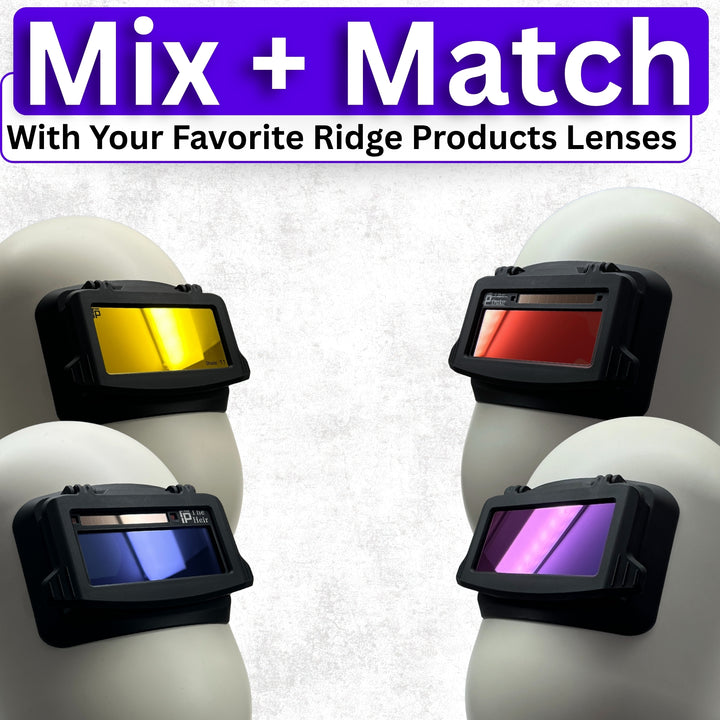
Auto-darkening lenses with True Color technology eliminate that green tint. The King gold adjustable auto darkening welding lens uses this so you can see the actual color of the puddle, which helps when you're reading the molten metal in out-of-position welding.
Sensors and Reaction Time
Auto-darkening helmets use sensors to detect the arc. Basic hobby helmets have two sensors, and industrial models have four or more for better coverage in tight spots.
Quality welding lenses darken in about 1/25,000th of a second, fast enough that UV rays don't reach your eyes. Cheaper helmets with slower reaction times wear your eyes out over a full day.
Viewing Area and Optical Clarity
Helmet weight matters more than you'd think. Even a few extra ounces add up over eight hours, and lighter helmets reduce neck strain.
Auto-darkening helmets weigh more than passive ones due to their electronics. But comfort also depends on how the headgear fits and distributes weight. Most auto-darkening helmets weigh between 450 and 650 grams (1-1.4 lbs). Look for helmets with 4- or 5-point suspension systems that evenly distribute weight across your head. Helmets weighing under 500 grams work best for full-day welding, as they help prevent neck and shoulder fatigue.
Safety Standards
Any welding helmet sold in the US has to meet ANSI Z87.1+ standards. If you're in Canada, you need to comply with CSA standards. These standards ensure the helmet can protect you from flying debris, extreme heat, and radiation.
Check that your helmet is marked with the right safety certifications to prove it's been tested and approved. The helmet needs to withstand high-velocity impacts and operate over a temperature range of -5°C to 55°C without failing.
Choosing the Right Helmet

Matching Helmet to Your Needs
What you need depends on what you actually do. A basic auto-darkening helmet works for stick welding in flat positions. TIG welding benefits from variable shade and good light state visibility. Understanding different types of welds will help you match them to your work.
If you work on a single welding process throughout your shift in a ventilated shop, focus on optical clarity and viewing area rather than respiratory protection. You’ll need more versatility if you're bouncing between processes or dealing with heavy fumes.
For professional use, budget $250-400 for helmets with 1/1/1/1 optical clarity rating, viewing areas at least 3.5" wide, reaction times under 1/25,000th of a second, and 4+ sensors for comprehensive arc detection.
Hobby welders can get by with mid-range auto-darkening helmets priced at $100-150. Look for at least two sensors, an adjustable shade range if you switch between processes, and decent optical clarity to reduce eye strain during practice sessions.
Making Your Decision
Start by identifying your primary welding process and work environment. If you do 80% or more of a single process (MIG, TIG, or stick) in one position, you can save money with a fixed-shade auto-darkening helmet. If you switch between processes daily or work in multiple positions (flat, vertical, overhead), invest in variable shade. If you weld galvanized or stainless steel, or work in poorly ventilated spaces for more than two hours per week, respiratory protection is essential for long-term health.
If you're just starting out or you weld occasionally, a decent auto-darkening helmet with fixed shade should work without spending on features you don't need. Test the helmet if possible. It should feel balanced when you tilt your head forward and back, with no pressure points on your forehead after 15-20 minutes of wear.
If you're welding professionally, see your helmet as an investment. Better visibility helps you do better work, and less weight means your neck doesn't hurt. A great add-on would be respiratory protection to keep the fumes from harming your lungs.
Ultimately, the best welding helmet is the one you’ll actually wear comfortably and see through clearly, without having to flip it up constantly. Choose a welding hood that works well enough for you to keep it down and stay comfortable.
Conclusion
Selecting the right welding helmet means matching lens technology and comfort features to your specific work. Passive helmets suit repetitive production jobs, auto-darkening helmets eliminate constant flipping and reduce neck strain, and PAPR helmets protect respiratory health in high-fume environments. Invest in the best optical clarity, lightest weight, and fastest reaction time you can afford. Your helmet is safety equipment you'll use every session, protecting both your immediate safety and your ability to weld comfortably for years.